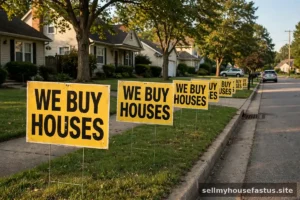
“We buy houses for cash!” The signs are stapled to telephone poles, the postcards fill your mailbox, and the TV ads promise a fast, hassle-free sale. Cash home buyers are a real and legitimate part of the US housing market — but they’re also one of the most misunderstood. Some sellers get a fast, fair deal. Others leave tens of thousands of dollars on the table without realizing it.
This guide gives you the honest pros and cons — no sales pitch, no scare tactics — so you can decide whether a cash buyer is right for your situation.
How Cash Home Buyers Actually Work
A cash home buyer is typically an individual investor or an investment company that purchases properties directly, without a mortgage. Because there’s no lender involved, there’s no appraisal contingency, no underwriting delay, and no risk of the buyer’s financing falling through — the three things that most often derail traditional sales.
The process usually looks like this: you contact the buyer (or they contact you), they evaluate the property — often with a brief walkthrough — and they make an offer, sometimes within 24 hours. If you accept, they open escrow with a title company, and closing happens in as little as 7 to 14 days. Most buy as-is, meaning you don’t repair, clean beyond basics, or stage anything. Learn what selling as-is really means before you sign, because “as-is” has specific implications for price and disclosures.
Cash buyers make money by renting the property, renovating and reselling it, or wholesaling the contract to another investor. Their offer has to leave room for all of that — which is the root of both the biggest pro (speed) and the biggest con (price).
The Pros: Why Sellers Choose Cash Buyers
1. Speed and certainty
This is the headline advantage and it’s real. A cash sale can close in one to three weeks. There’s no buyer waiting on loan approval, no appraisal coming in low, no last-minute financing collapse. When sellers say they chose a cash buyer, “certainty” is the word they use most — knowing the sale will close, on a specific date, has genuine value when you’re relocating, settling an estate, or stopping a foreclosure.
2. Sell as-is, no repairs or showings
No fixing the roof. No repainting. No keeping the house show-ready for weeks of strangers walking through. For sellers with distressed properties, hoarding situations, or homes that haven’t been updated in decades, this alone can make a cash sale the practical choice. It also matters for out-of-state owners who can’t manage contractors from afar.
3. Few or no fees and commissions
Most cash buyers don’t charge commissions, and many cover standard closing costs. Compare that with a traditional sale, where commissions and closing costs can take a meaningful bite — see the full cost of selling a house breakdown. The absence of fees doesn’t erase the price discount, but it narrows the gap.
4. Flexible terms
Need to close in 10 days? Many cash buyers can. Need 60 days to find your next place, or a lease-back after closing? Investors are often more flexible than retail buyers on possession dates, because they’re not trying to move in next weekend.
5. They buy houses traditional buyers won’t touch
Fire damage, foundation issues, code violations, inherited homes full of belongings, tenant-occupied properties — cash buyers specialize in the houses that would struggle on the MLS. If your property would need $50,000 of work before a mortgage lender would even approve a buyer’s loan, an investor may be your most realistic buyer.
The Cons: The Honest Downsides
1. You will get less than market value
This is the big one, and there’s no way around it: cash buyers pay below what your house would fetch in a competitive open-market sale. The discount compensates them for repairs, holding costs, resale risk, and profit. How much cash buyers pay varies enormously — property condition, local demand, and the buyer’s business model all move the number — but you should assume a meaningful gap versus a retail sale and get competing offers to find out exactly how big it is for your house.
2. High-pressure sales tactics exist
The legitimate industry has a fringe problem. Some operators use exploding offers (“sign today or the price drops”), scare tactics about foreclosure, or contracts with assignment clauses that let them shop your contract to other buyers. A reputable buyer gives you time, puts everything in plain writing, and never asks for upfront fees. Our guide to companies that buy houses for cash includes a vetting checklist — use it.
3. The offer can change after inspection
Many cash offers are made sight-unseen or after a quick walkthrough, then “confirmed” after a deeper inspection. That second look is where some buyers renegotiate downward — sometimes fairly (they found real problems), sometimes as a deliberate bait-and-switch. Get the inspection terms in writing: what triggers a price change, and can you walk away if it does?
4. Not every “buyer” is actually buying
Wholesalers put your house under contract with no intention of closing themselves — they plan to assign the contract to a real investor for a fee. If they can’t find one, your sale collapses weeks later. Ask directly: “Are you the buyer, or will you assign this contract?” Get the answer in the contract.
5. You lose the power of the open market
A listed home can attract multiple bidders who push the price up. A cash sale is a negotiation with one party who knows you want speed. That asymmetry is exactly why competing cash offers matter so much — you’re recreating, in miniature, the competition the open market would have given you.
Cash Offer vs. Listing: A Net-Proceeds Example
Abstract pros and cons only go so far — here’s what the trade-off looks like with numbers. Take a home worth about $280,000 on the open market:
- Cash buyer at $225,000: no commission, buyer covers most closing costs (say $2,000 on your side), close in 12 days. Net: roughly $223,000 — in your account in under two weeks, with zero showings and zero repair risk.
- Agent listing at $280,000: sells in 50 days for $275,000 after negotiation. Commissions and closing costs around 8% ($22,000), plus 50 days of carrying costs (~$3,000). Net: roughly $250,000 — about $27,000 more, nearly two months later, after inspections, an appraisal, and weeks of keeping the house show-ready.
Is $27,000 worth two months, dozens of showings, and the risk that the buyer’s financing falls apart? For many sellers, yes. For a seller facing foreclosure next month or managing an inherited property from across the country, no. There’s no universally right answer — but now you can see the actual shape of the decision instead of guessing.
Who Cash Buyers Are Right For
A cash sale tends to make sense when at least two of these are true:
- You need to close within 30 days (relocation, foreclosure timeline, divorce decree, probate costs mounting).
- The property needs significant work you can’t or won’t do.
- You own the home free and clear or have enough equity that the discount doesn’t wipe you out.
- You’re selling from a distance and can’t manage showings, repairs, or tenants.
- Certainty matters more to you than squeezing out the last dollar.
It tends to be the wrong choice when you have time, the house is in good condition in a desirable area, and you have significant equity — that’s the profile that benefits most from the open market.
How to Get a Fair Cash Offer
- Get 3+ offers. Contact multiple local investors and at least one national buyer. The spread will educate you fast.
- Know your baseline. Look up recent comparable sales so you can calculate the discount each offer implies.
- Ask for proof of funds. A legitimate cash buyer can show a bank statement or hard-money pre-approval. No proof, no deal.
- Read the contract. Look for assignment clauses, inspection contingencies that allow unlimited renegotiation, and any upfront fees (there shouldn’t be any).
- Compare against listing. Ask one agent what they’d list it for and what you’d likely net. Then decide with real numbers, not guesses.
Frequently Asked Questions
Are cash home buying companies legitimate?
Many are — it’s a real business model used by thousands of investors. But the industry’s low barrier to entry attracts bad actors too. Verify proof of funds, check reviews and BBB complaints, and never pay upfront fees.
How fast can a cash buyer close?
Seven to 14 days is common once under contract; three weeks is comfortable. The main variable is title work — liens and heirship issues slow down cash closings just like any other sale.
How far below market value do cash buyers go?
There’s no fixed number — it depends on condition, market, and the buyer’s model. Rather than relying on rules of thumb, get multiple offers and compare each against recent comparable sales. That’s the only discount figure that matters: yours.
Do I need to clean out the house?
Usually not fully — most cash buyers will take the property with belongings inside, sometimes charging a cleanout fee or factoring it into the offer. Ask upfront; “we handle everything” should be in writing.
Can I sell to a cash buyer if I still have a mortgage?
Yes — the cash buyer pays off your mortgage at closing from the purchase price, and you keep the difference (your equity). This works as long as the offer exceeds what you owe; if it doesn’t, you’re looking at a short sale instead, which needs your lender’s approval.
The Bottom Line
Cash buyers offer something genuinely valuable — speed, certainty, and simplicity — at a real and measurable price. Whether that trade is worth it depends on your deadline, your property’s condition, and your equity. Get multiple offers, know your numbers, vet the buyer, and you’ll make the decision with eyes open. That’s all any seller can ask for.