
Most sellers think of auctions as a last resort — the dramatic courthouse-steps foreclosure sale. But voluntary real estate auctions are a legitimate, mainstream selling method with a unique superpower: a guaranteed sale date. When you need certainty about when more than certainty about how much, auctions deserve a serious look.
This guide explains how residential auctions actually work, the types of auctions, honest pros and cons, what they cost, and how to decide if an auction fits your situation.
How a Residential Auction Works
The process has four phases. Marketing (3–6 weeks): the auction company photographs, lists, and advertises your property — online listings, email blasts to investor lists, signage, sometimes open houses. This phase is critical: auction results are made or lost in the marketing, not on auction day. Bidding: on auction day (live, online, or both), registered bidders compete. Contract: the winning bidder signs a purchase contract immediately — usually with a non-refundable deposit (often 5–10%) on the spot. Closing: typically 30–45 days later, similar to a traditional sale’s back end.
Total elapsed time from hiring the auctioneer to closing: roughly 6–10 weeks. Slower than a cash buyer, comparable to an aggressive listing — but with a sale date circled on the calendar from day one.
The Types of Auctions
Absolute auction (no reserve)
The property sells to the highest bidder regardless of price. This generates maximum bidding excitement — buyers show up because they smell a deal — but you accept genuine downside risk. If only two bidders register, you might sell far below market. Absolute auctions are best for properties where any sale is a win: estate settlements, distressed properties, or land.
Reserve auction (minimum price)
You set a confidential minimum; if bidding doesn’t reach it, you’re not obligated to sell. This is the sane choice for most sellers — you get the auction’s competitive dynamics and date certainty with a price floor. The trade-off: savvy bidders know reserves exist and bid accordingly, so the excitement premium is smaller than absolute auctions.
Online auctions
Bidding happens over days or weeks on a platform, rather than in a single live event. Lower costs, wider bidder pool (anyone with internet), less theater. Many residential auctions are now online or hybrid. The extended bidding window can actually help prices — more time for more bidders to discover the property.
The Pros
- Date certainty. You know the sale date before marketing begins. For relocations, estate deadlines, and partnership dissolutions, this alone can justify the method.
- Competitive bidding can exceed expectations. Two determined bidders can push a price past what a negotiated sale would have achieved — auction fever is real, and it works in the seller’s favor.
- As-is, no contingencies. Auction terms are typically as-is with no financing or inspection contingencies (bidders do their diligence before bidding). The winning bid is a firm deal.
- No lingering listing. Your property never goes stale on the MLS. There’s no price-reduction spiral, no months of showings.
- Serious buyers only. Registration requirements and non-refundable deposits filter out lookers. Everyone bidding can perform.
The Cons
- Price uncertainty. The flip side of competitive bidding: thin attendance means a low price, and with absolute auctions you eat it. Even reserve auctions can disappoint if the reserve was optimistic.
- Smaller buyer pool. Most retail buyers don’t shop auctions — they want inspections, contingencies, and time to think. Your bidders are overwhelmingly investors, which caps the price at investor math. Compare with how cash buyers price — auction buyers think the same way.
- Costs. Auction companies charge a buyer’s premium (often 5–10% added to the winning bid, paid by the buyer) and/or a seller’s commission, plus marketing fees. Read the fee structure carefully — “no commission” marketing usually means the buyer pays the premium, which still depresses bidding.
- You lose control of the process. Once the auction is scheduled and marketed, pulling out is expensive or impossible. If your circumstances change mid-marketing, you’re committed.
- Financing friction. Most auction purchases are cash or hard money. If you were hoping a retail buyer with a mortgage might bid, they’ll struggle with the no-contingency terms and 30-day close.
What Auctions Cost
Auction compensation comes in three forms, and listings often emphasize only the attractive one:
- Buyer’s premium (5–10%): added to the winning bid and paid by the buyer. Economically, it comes out of what bidders are willing to bid — a 10% premium means bids run ~10% lower than they otherwise would. It’s not free money; it’s a cost split.
- Seller’s commission: some auctioneers charge the seller a percentage instead of or in addition to the buyer’s premium.
- Marketing fees: photography, advertising, signage — sometimes flat-fee, sometimes deducted from proceeds. Get the marketing plan in writing: a cheap auctioneer who doesn’t market is the most expensive option.
All-in, auction costs often total 8–12% of the price — comparable to a traditional sale’s selling costs. The auction isn’t a discount method; it’s a certainty method. Judge it on that basis.
Which Properties Do Well at Auction?
- Estates and inherited properties — heirs want a date and a clean split; auctions deliver both.
- Unique or hard-to-price properties — where comparable sales don’t exist, bidding discovers the price better than an agent’s guess.
- Distressed properties — the as-is, no-contingency format matches the investor buyer pool.
- Land and rural properties — thin comparable data, wide buyer geography; auctions aggregate demand.
- Time-sensitive situations — divorce, partnership dissolution, relocation with a hard date.
Which properties do poorly? Ordinary suburban homes in balanced markets — the MLS serves them better, reaching retail buyers who pay emotional premiums investors won’t. Don’t auction a house the traditional market would love; you’ll leave the retail premium on the table.
Choosing an Auction Company
- Marketing plan in writing. Where will it be listed? How large is their bidder email list? What’s the advertising budget? Vague answers = thin attendance.
- Reserve terms. Can you set a reserve? Can you adjust it? What happens if bidding falls short — is there a post-auction negotiation period?
- Fee transparency. Every fee, who pays it, when. Including what happens if the property doesn’t sell.
- Track record with your property type. Ask for recent comparable auctions — addresses, bidder counts, sale prices vs. reserves.
- Contract flexibility. What if you get a great private offer during the marketing period? Can you accept it? At what cost?

Auction Day: What Actually Happens
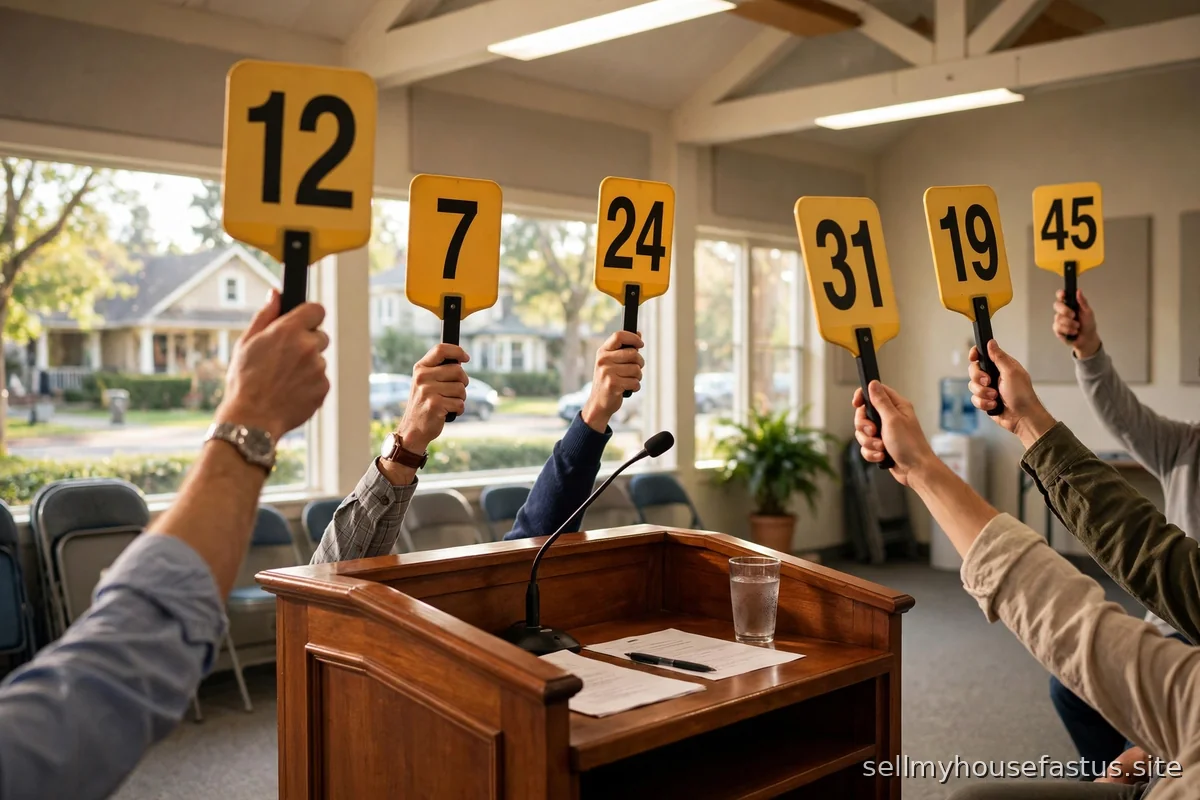
For live auctions: registered bidders gather (or log in), the auctioneer opens with the terms — deposit required, closing timeline, as-is conditions — and bidding starts, often below market to build momentum. The auctioneer’s chant drives the pace; each bid must top the last by the set increment. When bidding stalls, the classic “going once, going twice” closes it. The winner signs the contract and hands over the deposit immediately — there’s no “thinking it over.” The whole event often takes under an hour.
For online auctions: bidding opens for a set window (often 1–2 weeks), with the platform extending the deadline if last-minute bids arrive (anti-sniping). You’ll watch the bid history in real time. It’s less theatrical but more transparent — and the extended window means bidders who discover the property late can still participate, which is why online formats often produce stronger bidder counts than single-day live events.
Either way, your job on auction day is simple: stay out of the way and let the process work. Don’t hover, don’t signal disappointment at slow bidding, and don’t intervene — you’ve set your reserve, hired your auctioneer, and the market is speaking. That’s the deal you made, and it’s why choosing the right format and reserve beforehand matters more than anything that happens on the day.
Auction vs. Selling to a Cash Buyer Directly
These are the two “certain date” methods, so sellers often weigh them together. A direct cash sale to an investor is faster (1–3 weeks vs. 6–10) and simpler, but the price is a bilateral negotiation. An auction takes longer but lets multiple investors compete — and competition is the only reliable cure for the single-buyer discount. If you have 6+ weeks and your property will attract several bidders, the auction often nets more. If you need money this month, the direct sale wins. Our guide to comparing cash-buying companies covers the direct-sale side of this decision.
And for the timeline-obsessed: see how fast you can close with each method side by side.
Frequently Asked Questions
Should I choose absolute or reserve auction?
Reserve, in most cases. Absolute auctions generate more bidder excitement, but the downside risk — selling far below value on a thin-bidder day — is real and irreversible. Only choose absolute when any sale price is acceptable (estate liquidation, severe distress).
Do I need to attend the auction?
No — and many sellers prefer not to, since watching bidding stall below your hopes is stressful. Your auctioneer represents you. Online auctions make attendance a non-issue.
What happens if my house doesn’t sell at auction?
With a reserve auction, you’re not obligated to sell below reserve. Most contracts include a post-auction negotiation window where the highest bidder can negotiate with you directly. If it truly doesn’t sell, you’ve paid the marketing costs and learned the market’s verdict on your reserve — useful information for listing traditionally.
Can buyers get mortgages for auction properties?
Rarely in time. Auction terms usually require closing in 30 days with no financing contingency, which effectively limits bidders to cash and hard-money buyers. This is the structural reason auction prices reflect investor math.
The Bottom Line
Auctions trade price uncertainty for date certainty — a good bargain when the date matters more than squeezing the last dollar. Choose reserve over absolute, hire the auctioneer with the best marketing (not the lowest fee), and make sure your property is the kind that benefits from competitive bidding rather than retail emotion. Done right, auction day is the most exciting — and final — day of your sale.